Every router you have ever touched has been making a decision you never see:
which way a packet leaves. FRRouting is the free, open-source engine that
makes those decisions on more Linux boxes than any single vendor — and almost
nobody knows it exists until it breaks.
The invisible job
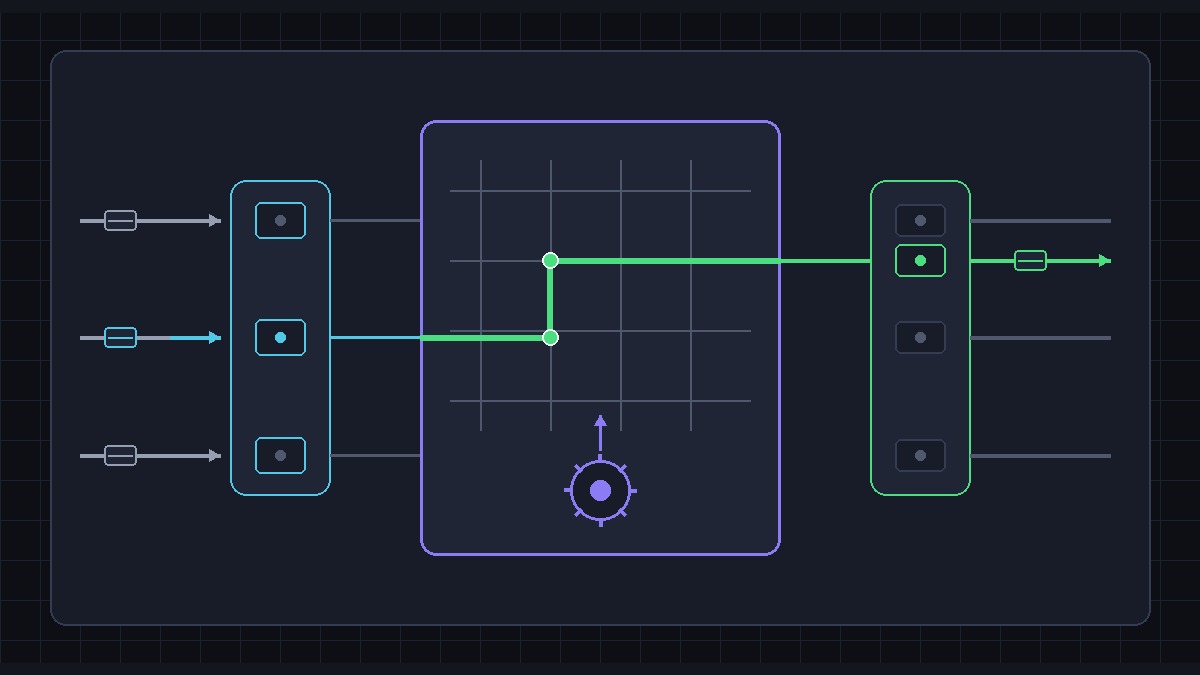
A router has exactly one job that matters: looking at where a packet wants to
go, and deciding which link it leaves by. Everything else — the blinking
lights, the CLI, the chassis — is there to support that one decision.
For most of the Internet's history, that decision was made by proprietary
software bolted onto expensive hardware. A router was a black box you bought
from a vendor, and the routing brain inside it was as secret as the recipe.
Then Linux became powerful enough to route real traffic, and a question
appeared: why does the routing brain have to be proprietary?
What FRRouting is
FRRouting (FRR) is the answer. It is a suite of free, open-source routing
daemons that turns an ordinary Linux machine into a router. It speaks the
Internet's routing protocols — BGP, OSPF, IS-IS, RIP, PIM, LDP, BFD — so the
box can talk to Cisco, Juniper, Arista and everyone else, as an equal.
It is a direct descendant of one of the oldest projects in networking. The
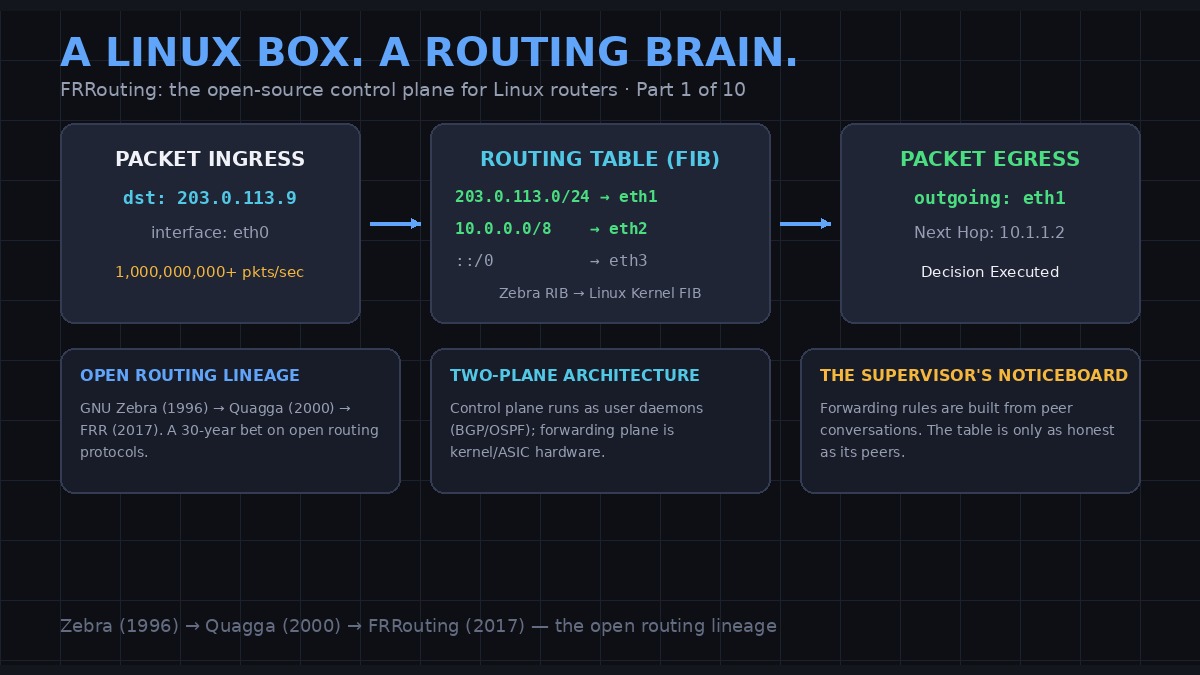
lineage runs GNU Zebra (1996) → Quagga (2000) → FRRouting (2017), and each
step was the same bet: that the control plane of the Internet should be a
piece of software you can read, change and run on anything.
The plain analogy
Think of a parcel-sorting warehouse. Every parcel (packet) arrives with a
destination label. A supervisor (the routing daemon) consults a giant
noticeboard (the routing table) that says: for addresses like this, use belt
3; for those, use belt 7.
FRR is the supervisor. The noticeboard it reads is built from what its peers
tell it over the routing protocols — and that is the part that matters for
everything that comes later in this series: the noticeboard is only as
trustworthy as the people allowed to talk to the supervisor.
Why you have probably touched it without knowing
FRRouting ships in the default repositories of Debian, Ubuntu and the
RHEL-family distributions. It runs on single-board computers in labs, on
white-box switches, on cloud instances doing BGP in a corner of a
datacenter, and inside several commercial network operating systems that
re-brand it and sell it as their own engine.
Its own documentation states production use by hundreds of companies,
universities, research labs and governments.
The looming problem, introduced
Here is what this series is really about. A routing daemon makes one of the
most consequential decisions in networking — which way traffic flows — and it
makes it from a picture of the network built by talking to strangers.
The protocols are designed so that only neighbours on the same link are
allowed to talk. Whether FRR actually enforces that boundary is the core
question, and the corpus this series is built on has found that in at least
one protocol, in every version ever released, it does not.
That is the disclosure — CVE-2026-119776 — and we are walking towards it the
same way every engineer walks towards a router fault: from the outside in.
Next: Part 2 — who actually runs FRR, and why they cannot simply stop.