FRR's own documentation says it in one line: production use by hundreds of
companies, universities, research labs and governments. The uncomfortable
truth is the list is longer than that — because a large part of it does not
know it runs FRR at all.
The spectrum of nobody
FRR sits at four different rungs of the networking ladder, and the userbase
problem is different at every rung:
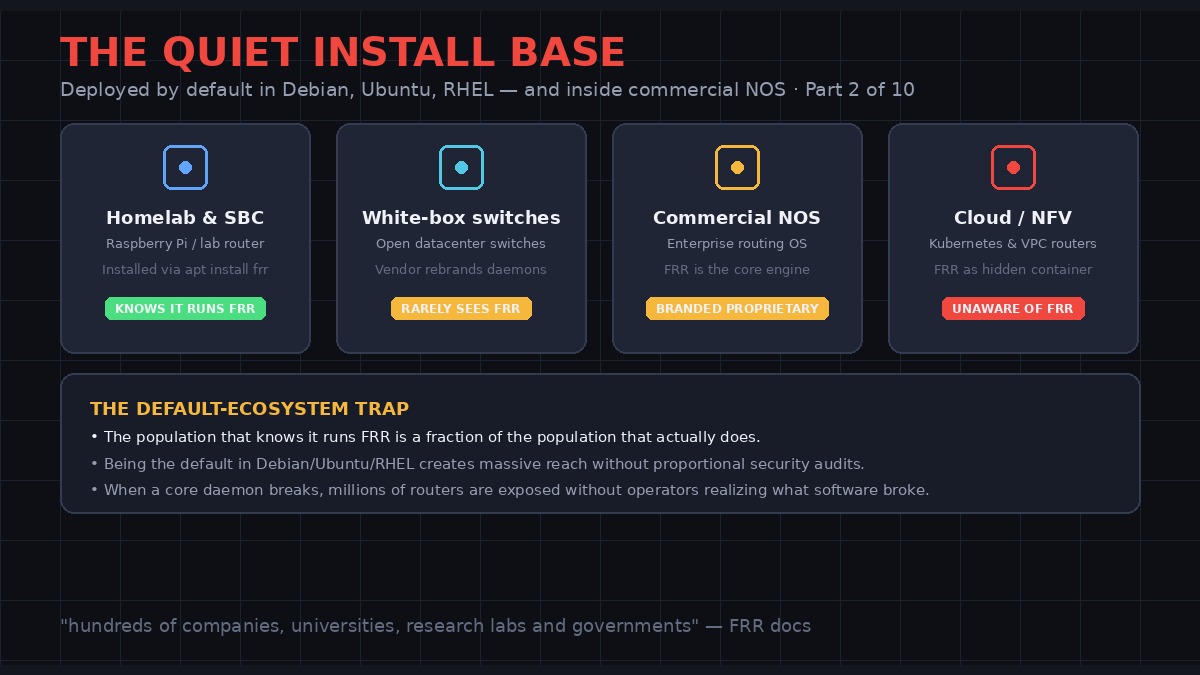
The homelab and the SBC. A network engineer builds a lab router from a
Raspberry Pi or an old PC, runs Debian, installs frr, and learns BGP at
home. This is the population that knows it runs FRR — because it typed the
install command.
The white-box switch. A datacentre buys an open switch, installs a
network operating system built on Linux, and that OS uses FRR as its routing
engine. The operator configuring BGP through the vendor's own CLI may never
see the word FRR — the vendor re-brands the daemons and ships them as
"the built-in routing stack".
The commercial NOS. Several commercial network operating systems — the
kind sold with support contracts — have FRR at their core. The customer buys
a routing platform; the platform is Linux plus FRR plus management layers.
When the marketing says "built on the industry's most battle-tested open
routing stack", it is talking about FRR.
The cloud. Cloud-native routing, Kubernetes networking, and virtual
routers for NFV use FRR as the control plane. In these deployments the
routing daemon is a container among containers, and the person responsible
for the platform may never have logged into a router CLI in their life.
Why they can't just stop
Every population above has the same constraint: the routing stack is the
one piece of the network you cannot 'pause' to think about. If the web
server breaks, you can take it out of the load balancer. If BGP breaks, you
lose the entire site, or the entire datacentre, or — in the IGP case — the
ability of the network to find itself at all.
And the routing stack is also the piece with the fewest alternatives, because
of a law of ecosystems: the default is what everyone standardised on.
Debian, Ubuntu, RHEL all ship FRR. Configurations are written for it.
Documentation assumes it. Training teaches it. When a router dies in a
thousand silent places, the replacement is another copy of the same thing.
The scale, honestly stated
The corpus records it plainly: FRR is "the default routing stack for
Linux-based routers" — shipping in the default repositories of the major
distributions, running on everything from single-board computers to
commercial routers, and acting as "the routing engine inside several network
operating systems and cloud-native routing products".
That is the userbase problem in one sentence. The population that knows
it runs FRR is a fraction of the population that does. And the fraction
that knows is the homelab crowd — the groups with the least dedicated
security staff watching over them.
The consequence of being default
Being the default has a security consequence that is easy to miss: the
number of eyes is not proportional to the number of deployments. One
thousand companies running FRR because it was in the repo does not give you
one thousand security reviewers. It gives you a handful of maintainers, a
foundation, and a bug tracker.
Which brings us to why this series exists. When a flaw is found in a routing
stack this widely deployed, the first question is not "is it a good bug" —
it is "how many of the people running this even know they are running
it?" For FRR, the honest answer is: fewer than you think.
And the reason that matters is about to become concrete, because the flaw we
are walking towards sits in the protocol that decides which link a packet
leaves by inside every autonomous system that uses IPv6.
Next: Part 3 — the eight jobs one process does, and why a routing suite is
a toolbox, not a single tool.