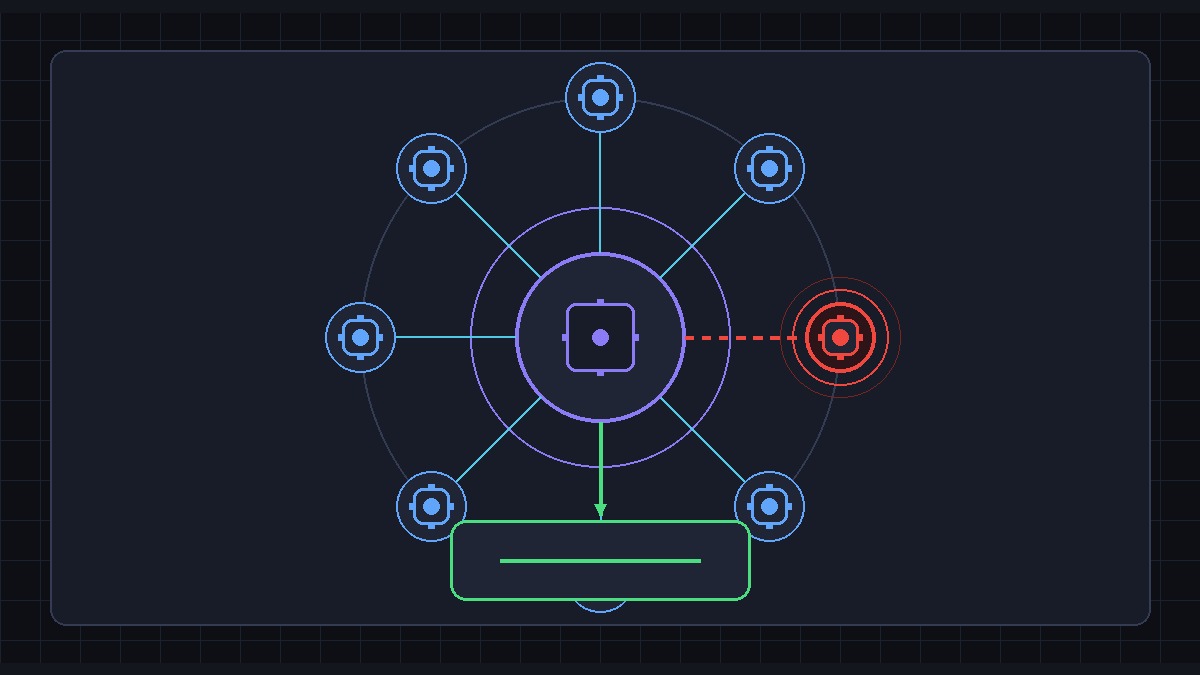
A routing suite is not one thing. It is a family of daemons, each speaking a
different protocol dialect, each solving a different problem — and one of
those dialects, OSPFv3, carries the flaw this series is walking towards.
The toolbox
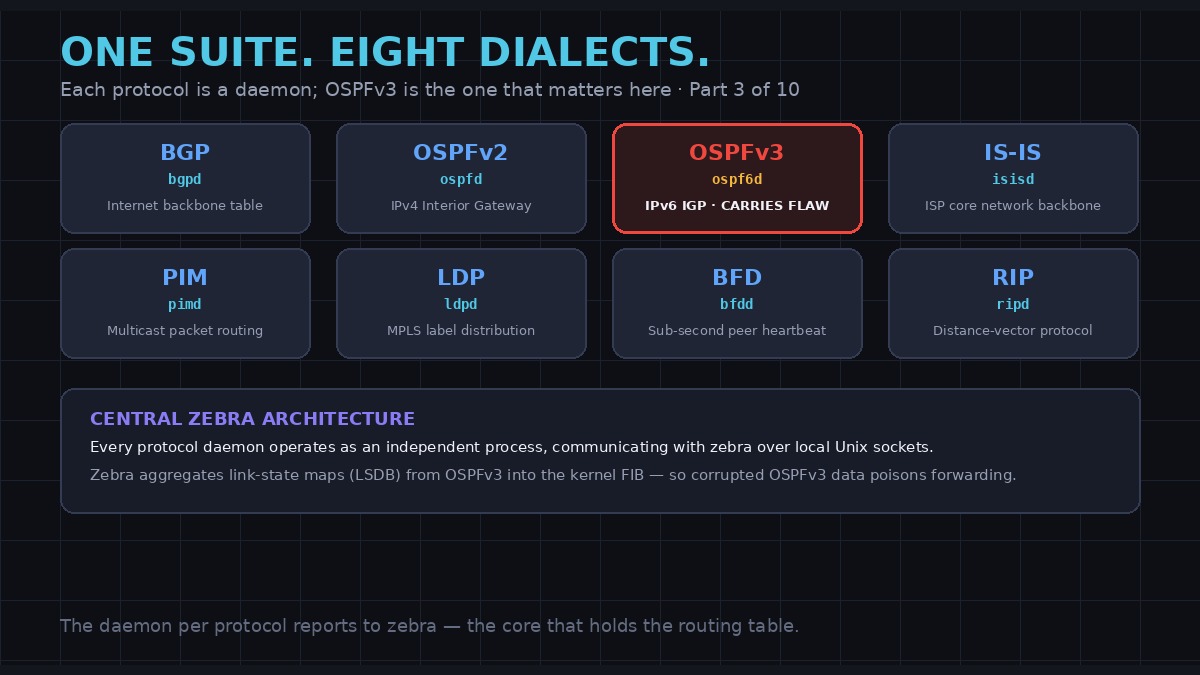
FRRouting bundles a set of routing protocols, each in its own daemon:
- BGP — the protocol of the Internet's backbone. It decides how
autonomous systems reach each other; it is how the worldwide table of
routes is exchanged between networks you do not own. - OSPFv2 and OSPFv3 — the interior gateway protocols. They run inside
one network (an autonomous system) and decide how packets travel between
routers that all belong to the same organisation. OSPFv2 is for IPv4;
OSPFv3 is for IPv6. - IS-IS — another interior protocol, the favourite of old ISP core
networks and large service-provider backbones. - RIP / RIPng — the old, simple distance-vector protocol; the router's
version of "ask your neighbour which way". - PIM — multicast routing: how one packet fans out to many receivers.
- LDP — label distribution for MPLS, the protocol that carves tunnels
through a network. - BFD — the heartbeat protocol: a fast way for routers to tell each
other "I am still here" in milliseconds.
Why a suite, why not one daemon
A router must speak many protocols because a real network is many networks
joined together: your LAN speaks OSPF, your provider speaks BGP, your core
speaks IS-IS, and your multicast streams speak PIM. The same physical router
sits at every junction. So FRR runs a daemon per protocol, and one central
daemon — the zebra-derived core — holds the collected routing table that
all protocols contribute to and that the kernel uses for actual forwarding.
This architecture is the classic Unix answer: small, focused processes that
communicate. One protocol crashing should not take the others down. That is
the design intent — and, as we will see, the isolation is not always
complete.
The one that matters for this series
For the disclosure ahead you need to understand the interior gateway
protocols — specifically OSPFv3 — from the inside out.
OSPF stands for Open Shortest Path First. It is called that because it works
by each router building a map of the whole network — the link-state database
(LSDB) — and then computing, with Dijkstra's algorithm, the shortest path
from itself to every destination. When a router hears about a change, it
re-floods the news to its neighbours; eventually every router recomputes.
Here is the fundamental social contract: the LSDB is only as truthful as
the people allowed to contribute to it. If an attacker can inject a router
into the map — can make a router believe a false neighbour exists — the SPF
computation will happily route traffic to the attacker. The map has no
opinion of its own; it routes wherever the data says.
That is why the protocol spends so much effort defining who is allowed to
talk. And the precise rules about who may speak OSPFv3 — the address
validations — are exactly the checks that the FRR implementation skips,
per the corpus's disclosure. The protocol's entire trust boundary rests on
those checks, and we will see in Part 7 what happens when the boundary is
simply not enforced.
The toolbox framing, and the stakes
So: FRR is a toolbox of eight protocols, and the toolbox is the default
routing brain for a huge slice of the Linux world. Every protocol in it is
a trust boundary — a conversation with a stranger that ends in the stranger
controlling your forwarding table.
The next parts look at why this toolbox won, how its design makes certain
failures invisible, and then walk directly into the check that was never
written.
Next: Part 4 — why the free routing suite won over the big appliance
vendors, and what that victory cost.