Every network technology wins for a reason, and the reason is usually a
trade: capability for simplicity, support for price, control for
convenience. FRRouting's victory over the proprietary appliance is the
biggest trade in modern networking — and the debt on that trade comes due
in ways this series is about to show.
The honest comparison
The routing daemon market has three real players plus FRR:
- The proprietary appliances — Cisco IOS, Juniper Junos, Arista EOS.
Mature, supported, certified. Also expensive, opaque, and tied to their
hardware. - The other open daemons — BIRD, OpenBGPD, GoBGP. Good at what they do,
but each is narrower: BIRD is a lean routing suite, OpenBGPD is the
OpenBSD project's daemon, GoBGP is BGP-focused for the API/cloud world. - FRRouting — the successor to GNU Zebra (1996) and Quagga (2000), the
protocol suite that the big Linux distributions chose.
When the comparison is about who runs on your own hardware, with your own
kernel, in your own data centre, FRR wins on reach: it is in every default
repo, it speaks every protocol, and it is fast enough.
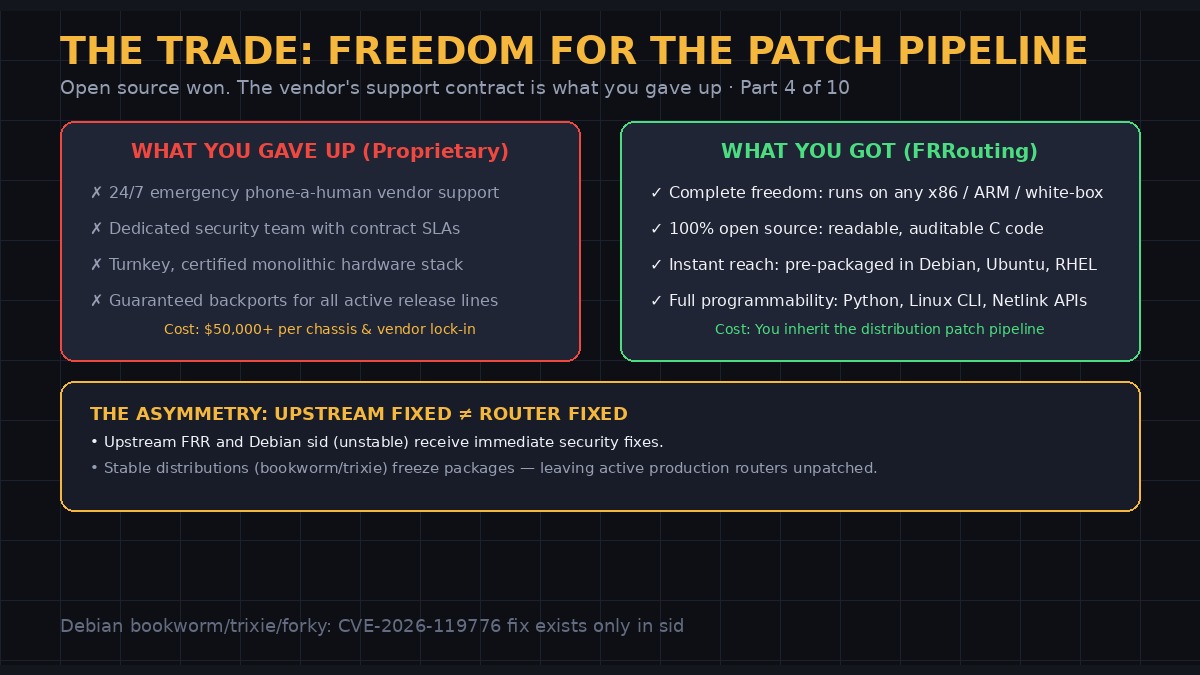
When the comparison is about who answers the phone at 3am, the appliance
vendor wins. That is the trade, stated plainly: you trade the support
contract for the freedom. Most of the networking world decided freedom was
worth it.
The trouble with the trade
Here is the part the victory speeches leave out. A support contract is not
just a phone number; it is a patch pipeline. When a vulnerability is
found, the vendor's security team — paid, obligated, accountable — produces
a fixed version and ships it to every customer.
An open-source routing suite has a different pipeline: maintainers, a
community, and — critically — the distributions that package it. The
quality of the pipeline now depends on the slowest link in the chain. For
FRR that link is not the project itself: it is the fact that Debian stable
freezes its packages and ships security updates on its own schedule.
The cost, made concrete
The corpus's disclosure for FRR already demonstrates the cost in one line:
the advisory affects "all prior released versions" and appears vulnerable
in a subset of Debian releases with the fix only in an unstable branch,
with no patched package in the stable suites where most deployments live.
Let that sink in with what Part 2 established. Most people running FRR are
running it because it is the default in the repo. They did not compile it;
they did not track upstream; they installed their OS, and the router came
with it. When a fix exists upstream but is not in the stable repository —
the fix might as well not exist for that population.
That is the real price of the trade: freedom from the vendor's lock-in is
paid for with responsibility for the vendor's patch pipeline. FRR's
own foundation (NetDEF) exists to sell support contracts, including
backports — which tells you the project itself knows that "the upstream
version is fixed" is not the same sentence as "your router is fixed".
The warning that comes with the trade
So the honest scorecard:
- FRR wins on openness, reach, price, and breadth — no one else comes
close on any of those. - FRR's owner is a foundation that runs on sponsorship; its users are
mostly anonymous, mostly on distribution packages, mostly without a paid
relationship with anyone who owes them a patch. - The consequence is that security response speed is variable; it
depends on the distribution, the maintainer, and the seriousness of the
bug — not on a contract.
For the disclosure ahead, remember this asymmetry: a bug in FRR does not
become "fixed" when the upstream commit lands. It becomes fixed when the
distribution you run ships it — and in the case of CVE-2026-119776, the
corpus records that for the stable suites, that moment has not arrived.
Next: Part 5 — the engine room: how the daemons actually trust each other,
and where the trust boundary really sits.