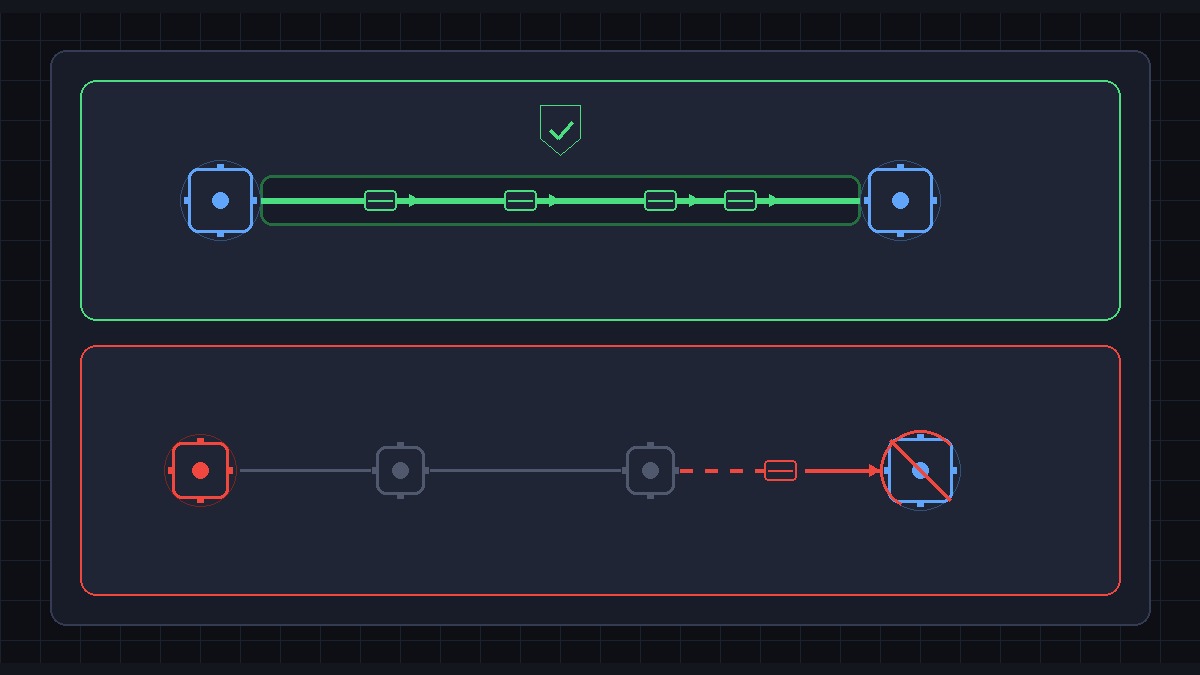
Before the flaw, you have to see the machine as it was designed: a room of
daemons passing routing information to each other on the understanding that
the people they talk to are who they say they are, and are where they say
they are. Understanding where that understanding breaks is the whole of the
disclosure.
The room
FRRouting is not one program; it is a family of daemons sharing a machine:
- zebra (the RIB manager) — the core. It holds the routing table, talks
to the kernel, and brokers information between all the other daemons. - bgpd — speaks BGP to other autonomous systems.
- ospfd / ospf6d — speak OSPFv2 (IPv4) and OSPFv3 (IPv6) inside the
network. - isisd, ripd, pimd, ldpd, bfdd — the rest of the toolbox from Part 3.
Each daemon collects routes from its protocol and hands them to zebra; zebra
picks the best path and installs it into the kernel's forwarding table. This
is the classic Unix design — small processes, clear interfaces — and it is
the architecture the whole series stands on.
The trust boundary, inside the room
Between the daemons, the trust is complete: they are all the same software,
running on the same machine, talking over local sockets. That is internal
trust, and it is fine.
The interesting boundary is external: the point where the daemon opens a
socket to the network and starts listening to strangers.
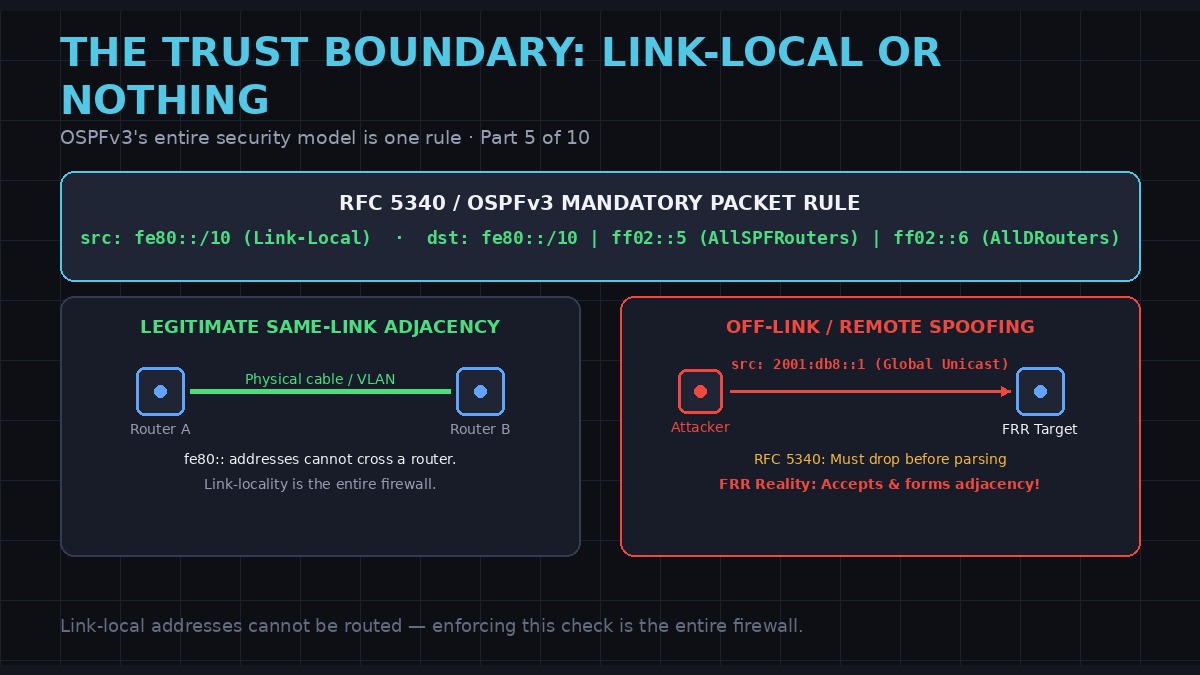
OSPF is the clearest case, because the protocol's whole security model is
one idea: only routers on the same link may talk to me. OSPF runs per-link,
not per-network. Legitimate OSPFv3 packets must come from a link-local
source address — an fe80::/10 address that only has meaning on that one
physical or logical link — and must be sent to either a link-local
destination or one of two reserved protocol multicast groups: AllSPFRouters
(ff02::5) and AllDRouters (ff02::6).
Why? Because link-locality is the protocol's entire isolation mechanism. A
link-local address cannot be routed; it dies at the edge of the link. So
requiring OSPFv3 to be link-local means only something physically attached
to this cable can pretend to be my OSPF neighbour. That is not a
convenience feature — it is the firewall.
Where the design puts its faith
Once that boundary is accepted, everything downstream is faith:
- A packet arrives claiming to be OSPFv3 from a link-local source.
- The daemon processes the Hello as coming from a neighbour on this link.
- The neighbour state machine walks Hello → 2-Way → ExStart → Exchange →
Loading → Full — and the two routers now have an adjacency. - The neighbour's LSAs (link-state advertisements) are installed into the
local link-state database. - SPF runs on the combined database, and forwarding is computed from it.
Every one of those steps is designed to be automatic: adjacency is trust,
and the database is gospel. The protocol provides no opinion, no audit, no
sanity check on the person at the other end of the Hello — it assumes the
address rules did that job upstream.
The load-bearing assumption
So the architecture comes down to a single load-bearing assumption:
A packet whose source address is not link-local was never meant to be
OSPFv3, so I can ignore it — and I know it could never get here anyway,
because link-local traffic cannot cross a router.
If an implementation ever fails to enforce that assumption — if it accepts
OSPFv3 packets from any source, over any reachable path — then the
protocol's firewall is gone while the daemon still behaves as if it were
standing: it will happily form adjacencies with, exchange databases with,
and compute forwarding from a speaker that has no business being on the
link.
That is precisely the failure the corpus describes for CVE-2026-119776:
FRRouting's OSPFv3 implementation not checking that OSPFv3 packets have
a link-local source address and either a link-local destination or one of
the protocol multicast destination groups. The firewall was assumed, and
it was not implemented.
Everything that follows in this series is the consequence of that one
missing sentence of code.
Next: Part 6 — how a missing check hides in plain sight: the failure is
silent because the protocol still works.