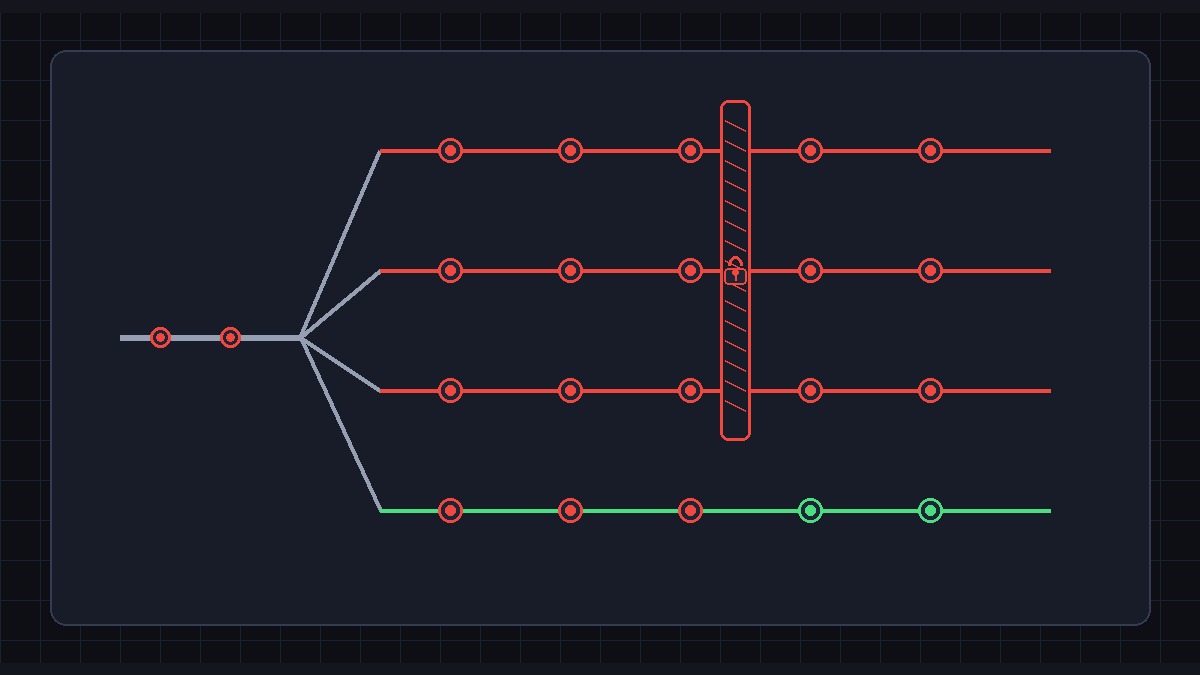
"All prior released versions" is the sentence that turns a protocol bug
into an operational trap. A regression has a moment of introduction and a
fix that might be backported. A check that was never written has no such
moment — and the corpus records that the distributions most people actually
run simply do not have the fix.
The sentence, unpacked
The advisory says the OSPFv3 implementation does not check link-local
source/destination in all prior released versions of FRRouting. The
corpus file adds the distribution reality:
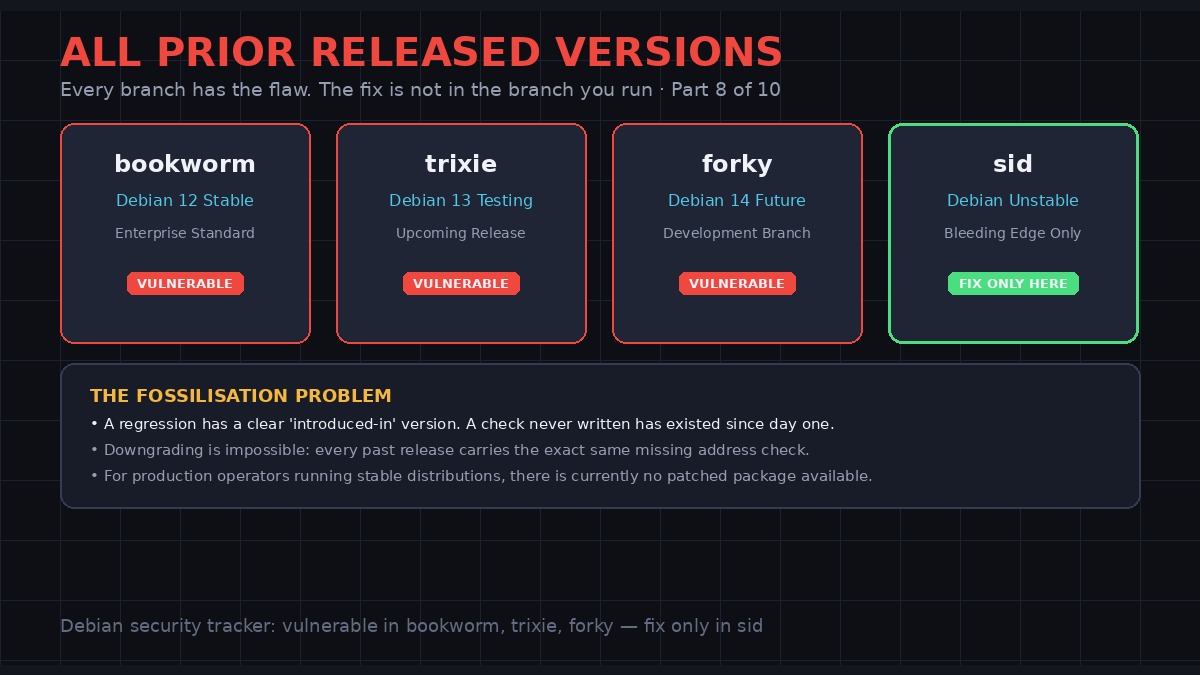
"Debian's security tracker records it as vulnerable in bookworm, trixie
and forky — every current stable and testing suite — with a fix only in
sid. For anyone running distribution FRR rather than a vendor build,
there is no patched package."
Read those two sentences together and you have the whole trap:
- The flaw has no version boundary. It did not arrive in some bad
release; it was never absent. There is no "upgrade past the buggy
version" — every version you could downgrade to is vulnerable. - The fix has a distribution boundary. It exists upstream (in FRR or in
Debian's unstable suite), but for the operator on a stable distribution,
the patched package does not exist.
The fossilisation problem
Part 4 established the trade: freedom from the vendor, paid for with the
patch pipeline. Part 8 is where that debt matures.
FRR is in the default repositories of Debian, Ubuntu and the RHEL family.
The users who run it are, by and large, the users who installed an operating
system — not a router vendor's release cycle. When the corpus says "for
anyone running distribution FRR rather than a vendor build, there is no
patched package", it is describing the majority of the install base: the
quiet backbone from Part 2.
An operator on Debian bookworm — a stable, supported, security-patched
distribution — runs an FRR with a control-plane injection flaw, and there is
no supported package that fixes it. The distribution's own security
apparatus processes CVEs, but a fix that only exists in sid is a fix that
does not exist for them.
Why backports lag
Routing daemons are hard to backport across distribution branches: the
patch touches adjacent state machines, the maintainer for the older branch
may be the same two people upstream who are busy with the current one, and
the security impact of a protocol change is judged conservatively. So the
older-branch fix slides — not out of malice, but out of the arithmetic of
unfunded maintenance.
The corpus's own scoring acknowledges the gap: the FRR entry is ranked 9th
of 26 at impact 6.89 with C=2 — the "C" being product coverage, the
likelihood that the control products you already bought would close the
gap. C=2 means the purchased mitigations reduce but do not remove the
exposure. For most operators the actual mitigations are the free ones —
which Part 10 covers.
The waiting population
So the picture at this point in the series:
- The flaw: a missing link-local check in OSPFv3, present in every
release ever shipped (Part 7). - The protocol aim: interior gateway routing for IPv6 — the protocol
that decides which link a packet leaves by inside an autonomous system. - The install base: the default routing stack of the Linux world
(Part 2), mostly running distribution packages (Part 4). - The patch reality: fixed upstream and in the unstable branch; absent
from the stable suites where the install base lives.
Everything that follows — the exploitation chain in Part 9 and the way out
in Part 10 — is about what that combination of facts means for a network
that runs FRR today.
Next: Part 9 — from a crafted Hello to a poisoned topology: the chain
that turns this missing check into traffic you never see again.