
The disclosure's headline is a security flaw, but the corpus records
smaller, earlier failures in FRR that matter for the same reason: a routing
daemon that loses its state silently is a routing daemon whose decisions you
cannot trust, security bug or not. Walk the escalator one rung at a time.
The pattern in the corpus
The routing-daemon scan in the corpus's 08-routing-daemon-nos-bugs.md
lists the open FRR issues. None of them is a CVE. All of them share one
shape: state that should have been cleared is left behind, and the
forwarding behaviour diverges from what the configuration says.
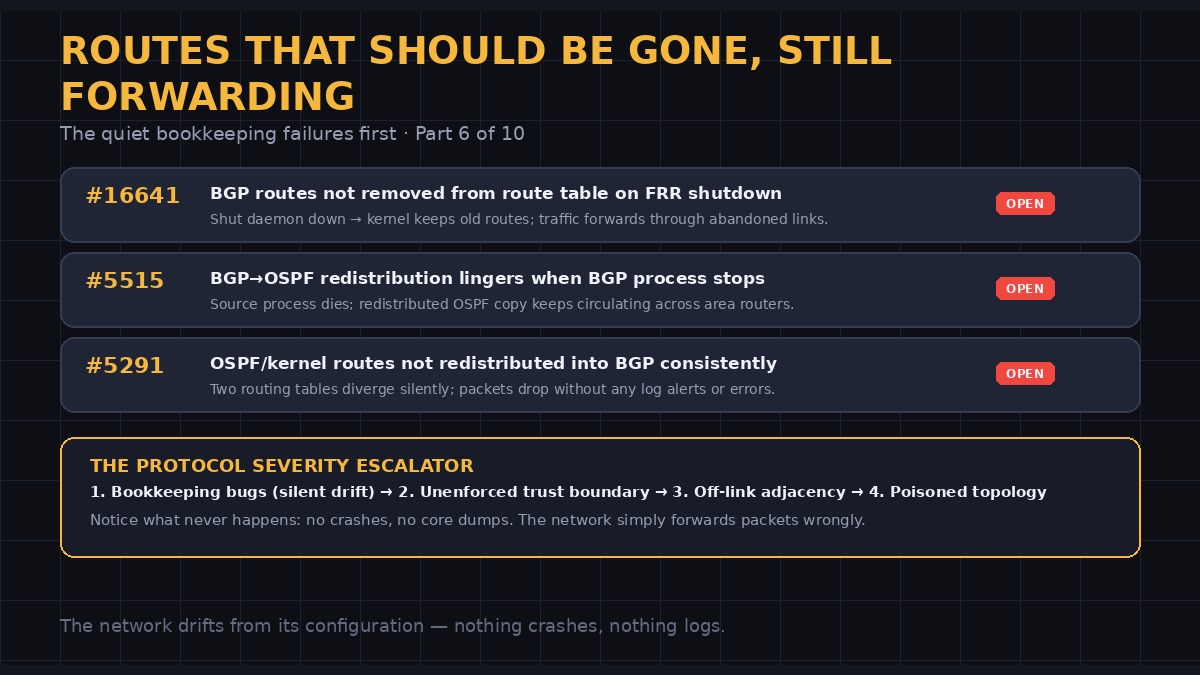
- #16641 — BGP routes not removed from the route table when FRR shuts
down. Shut the daemon down and routes that were supposed to disappear
stay in the kernel table. The router keeps forwarding through links its
own process has already abandoned. - #5515 — redistribution BGP → OSPF: routes learned from a BGP peer are
not removed when the BGP process is stopped. Same shape, one layer up:
the route was redistributed into OSPF, the source died, and the
redistributed copy keeps circulating as if the source still existed. - #5291 — OSPF/kernel routes not redistributed into BGP consistently.
Same family again: the two tables disagree about what exists, and nothing
notices.
These are the friendly failures of routing software: no attacker involved,
just a daemon whose bookkeeping disagrees with reality.
Why they matter more than they look
Individually, each is a nuisance. Collectively, they describe the failure
mode this series cares about: a routing control plane whose state machine
is not trustworthy, in ways that are invisible from the outside.
A route left behind in the kernel table after shutdown is not just
archaeology. Traffic keeps flowing through a path the network believes is
gone. In a quiet network, that can persist for months — long enough to be
relied upon, and long enough that when the larger claim about FRR lands in
Part 7, the pattern is already familiar: FRR trusts its own state, and
its state is not always true.
The escalator, one rung
The corpus's disclosure files are meant to be read in ascending severity.
For FRR the rungs look like this:
- Rung one — bookkeeping. Routes forgotten on shutdown, redistribution
arguments between daemons. Nothing breaks loudly; the network just drifts
from its configuration. (This part.) - Rung two — the trust boundary. The protocol's isolation mechanism —
link-local addressing — is not enforced where it was supposed to be.
(Parts 5 and 7.) - Rung three — a stranger walks in. With the boundary unenforced, a
packet from nowhere is treated as a neighbour. (Part 8.) - Rung four — the map lies. The neighbour injects state into the
link-state database, SPF recomputes, and traffic goes where the attacker
says. (Parts 8 and 9.)
Notice what does not appear anywhere on the escalator: a crash. None of
these failures needs the daemon to stop. The protocol keeps working —
forwarding keeps happening — wrongly. That is the quiet quality that runs
through every FRR finding in the corpus, and it is the most dangerous one.
The design reason
Why does a routing suite fail this way? Because routing protocols are
state machines with a giant memory: every adjacency, every LSA, every
redistribution mapping wants to persist until explicitly torn down. The
author of a state machine writes the harder half — establishing state —
and the teardown paths that are never exercised in a lab stay
under-written. Shutdown, process death, and redistribution removal are
exactly the paths nobody rehearses at scale.
The fix for every one of these smaller issues exists upstream and is
routine engineering. They are not the disclosure. They are the warm-up:
FRR's real problem, the one the corpus ranks 9th of 26 at impact 6.89, is
not a forgotten table. It is a firewall that was never installed.
Next: Part 7 — the first and most fundamental flaw: CVE-2026-119776, the
OSPFv3 check that was never written.

Comments (0)