
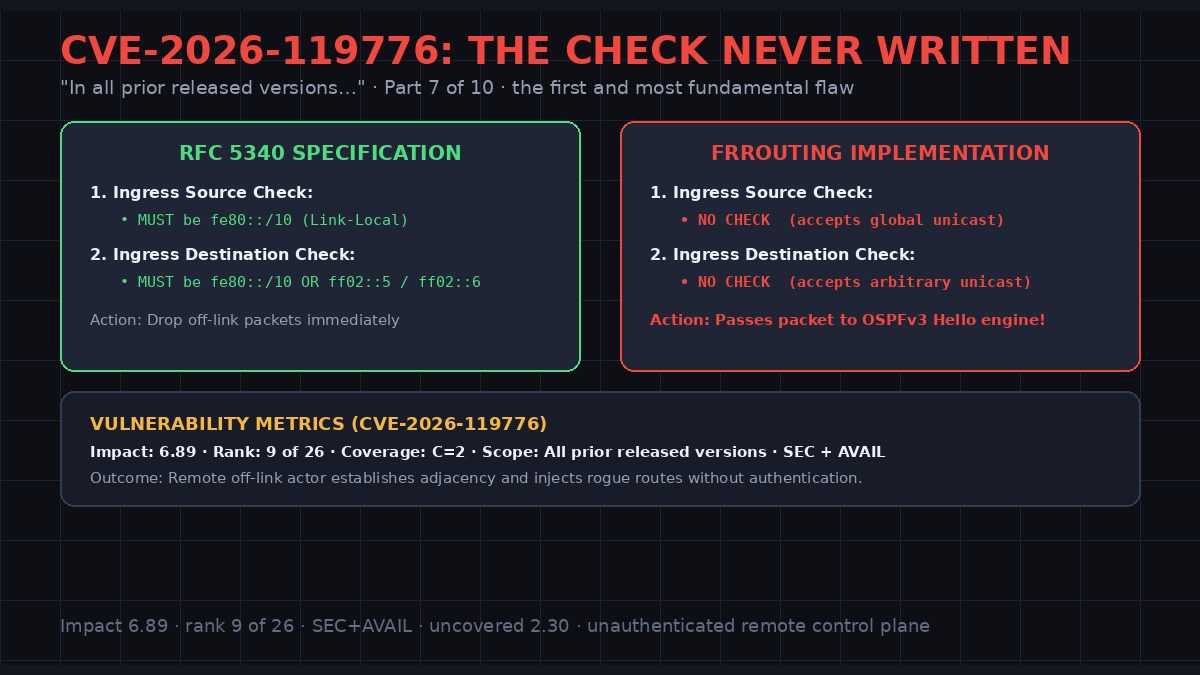
Everything so far was groundwork. This is the flaw — the first entry for
FRR in the corpus's deep-dive index, and the most fundamental: an OSPFv3
implementation that never checks where a packet came from, in every version
ever released.
The corpus file, quoted
From the corpus's deep-dive file 04-frrouting-cve-2026-119776.md:
"In all prior released versions of FRRouting, the OSPFv3 (for IPv6)
implementation does not check that OSPFv3 packets have a link-local source
address and either a link-local destination or one of the protocol
multicast destination groups. This may enable malicious actors to
establish OSPFv3 adjacency…"
Two details carry the weight, exactly as the corpus notes:
"All prior released versions." This is not a regression introduced in one
branch and fixed in the next. Every FRR release before the fix has the
defect. The check was simply never written.
"Establish OSPFv3 adjacency." The outcome is not a crash. It is an
attacker speaking OSPFv3 to your router — and being believed. The router
will treat the attacker as a neighbour, exchange its link-state database
with it, and compute its forwarding table from what the attacker offers.
What the check was supposed to do
Part 5 set the scene: OSPFv3 runs per-link and is scoped to the link.
RFC 5340 is explicit about where an OSPFv3 packet may come from:
- the source must be a link-local address (fe80::/10) — an address that
only exists meaningfully on the local cable; and - the destination must be link-local or one of the reserved protocol
multicast groups — AllSPFRouters (ff02::5) or AllDRouters (ff02::6).
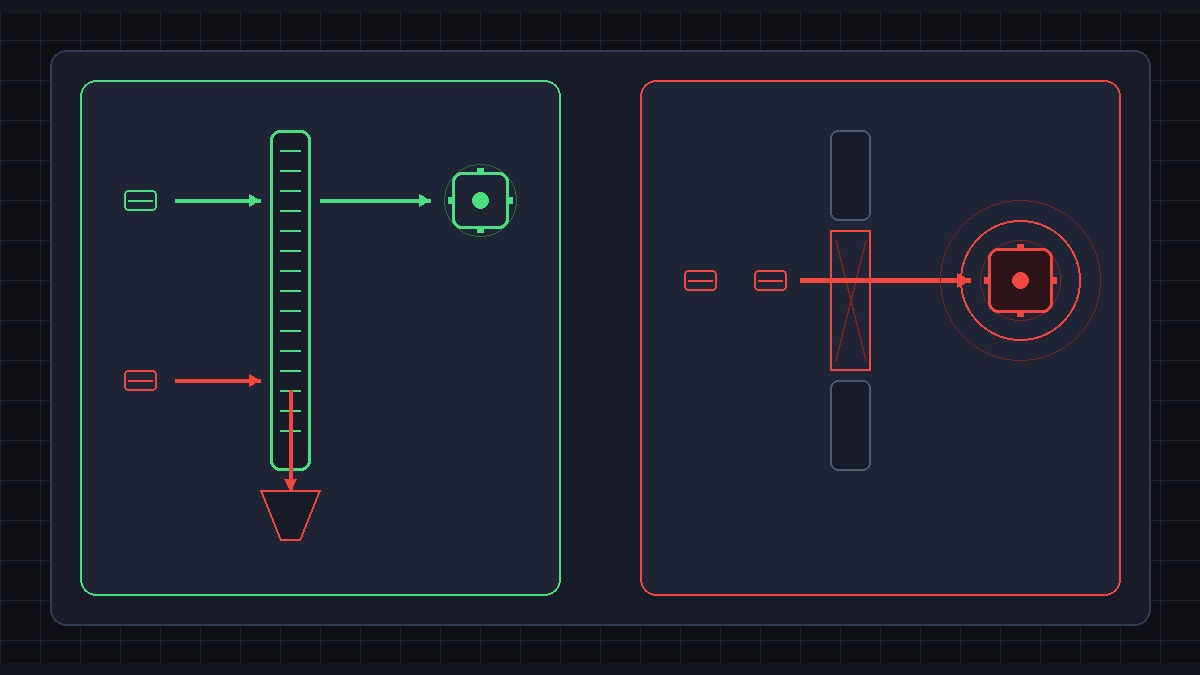
That restriction is not cosmetic. It is the protocol's entire isolation
mechanism. It is why an OSPFv3 speaker can only form adjacencies with
routers that are on the same physical or logical link. Without it, OSPFv3
becomes reachable from anywhere that can route a packet to the router's
address — and the interior gateway protocol becomes an unauthenticated
remote control plane.
FRR's implementation does not check either condition: it accepts OSPFv3
packets whose source is not link-local, and whose destination is neither
link-local nor a protocol multicast group.
The cascade, step by step
The corpus spells out what follows from that single missing check:
- Off-link adjacency. A packet arriving from a global or arbitrary
source is processed as a legitimate OSPFv3 Hello. - The neighbour state machine accepts it. FRR forms an adjacency with a
speaker that has no business being on that link. - Database exchange proceeds. The attacker offers LSAs; FRR accepts and
installs them. - The link-state database is now attacker-influenced — Router-LSAs,
Network-LSAs, any LSA type the attacker can produce. - SPF runs on poisoned data. Forwarding tables are recomputed from the
attacker's view of the topology.
Note what is not required, the corpus is careful to point out: no
authentication bypass is described, because OSPFv3 authentication (IPsec
AH/ESP, or RFC 7166) is optional and frequently unconfigured. Even where it
is configured, the missing address check means the packet reaches the
authentication stage at all — widening the attack surface for anything
downstream.
Why the design allowed it
Three reasons, each traceable to earlier parts:
- The check is easy to omit and impossible to notice. Validating the
source address requires knowing which interface a packet arrived on and
comparing against its link-local prefix — per-packet context that a
socket-based implementation can lose. On Linux, raw sockets with
IPV6_RECVPKTINFOmake this possible; implementations that read from a
plain IPv6 socket may not have the inbound-interface metadata readily
available. - The failure is silent because the protocol works. A spoofed adjacency
behaves exactly like a real one. No error, no log line, no counter — the
only artefact is a neighbour that should not exist. - The ecosystem treats the IGP as trusted (Part 5). OSPF is designed for
a perimeter you control; "nobody can send us OSPFv3 from outside the
link" was exactly the assumption the RFC's address rules were built to
enforce — and FRR did not implement it.
The score reality
The corpus ranks this 9th of 26 bugs at impact 6.89 (C=2, uncovered
2.30, SEC+AVAIL), noted as "vulnerable in Debian stable" — and the
deep-dive file is marked C=2 because the purchased mitigations (RPKI and
BGP monitoring) do not see IGP-layer attacks at all. On the probability
calculus, an unauthenticated remote control-plane injection into the
default routing stack of the Linux world sits far higher than a mid-table
severity score suggests.
Next: Part 8 — "all prior released versions": what it means when the flaw
lives in every branch, and the versions that will never be fixed.

Comments (0)