
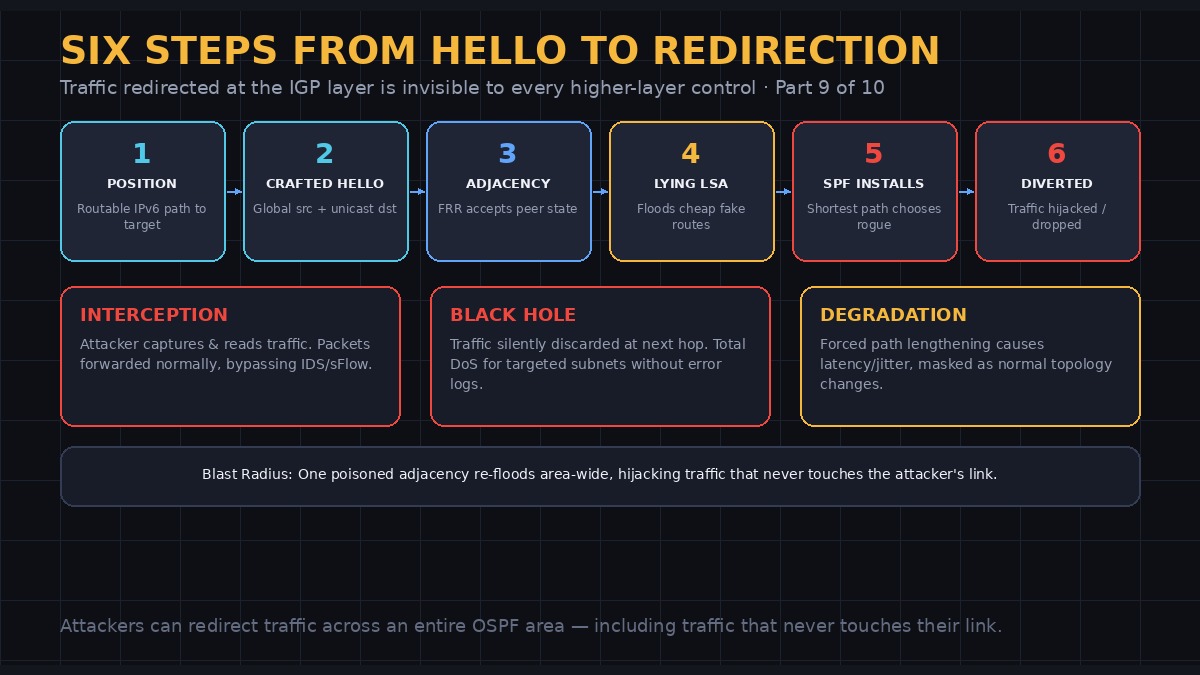
The corpus holds the chain in six steps. The important thing about it is
not the first step — which is small — but the last: traffic redirection at
the IGP layer is invisible to every higher-layer control, because the
packets are correctly addressed and correctly delivered, just to the wrong
next hop.
The chain, step by step
From the corpus file 04-frrouting-cve-2026-119776.md:
- A position. The attacker obtains a position that can deliver IPv6
packets to the target router — the same segment, a routed path, a
tunnel, or transit. Note the flexibility: it does not need to be on the
link. That is the whole point of the missing check. - A crafted Hello. The attacker sends an OSPFv3 Hello with a
non-link-local source and a unicast or non-protocol destination. Because
FRR does not validate either field, the packet is processed as a
legitimate OSPFv3 packet. - Adjacency. FRR accepts the Hello, forms an adjacency, and starts
database exchange with the attacker. - A lying Router-LSA. The attacker floods a Router-LSA claiming to be a
router with attractive connectivity — a low-cost path to everything. - SPF computes. FRR's shortest-path computation installs the
attacker's routes into the forwarding table. - The traffic goes to the attacker. Either interception (traffic is
redirected to the attacker), or a black hole (traffic is dropped —
denial), or a longer path (silent degradation that looks like a normal
topology change).
Why step 6 is the real damage
Every earlier part was building toward this sentence from the corpus:
"Traffic redirection at the IGP layer is invisible to every higher-layer
control, because the packets are correctly addressed and correctly
delivered — just to the wrong next hop."
Think about what that means for every monitoring system a network owns:
- Flow analytics (NetFlow / sFlow) see packets moving. They see correct
addresses, correct sizes, correct protocols. Nothing flags the traffic as
anomalous — it is correctly forwarded, by definition. - IDS/IPS see sessions. The sessions complete. An intercepted TLS
session to a legitimate host behaves like the legitimate session, just
terminated at the attacker's machine first. - Traffic redirection looks exactly like normal forwarding. This is the
point at which "but we'd notice" becomes "we didn't".
The blast radius: why one adjacency corrupts the whole area
Now the second force multiplier. OSPF is an interior gateway protocol, and
its database is shared by flood:
- One injected adjacency on one router lets the attacker feed LSAs into the
local link-state database. - Those LSAs are re-flooded by every other router that accepts them —
that is what OSPF routers do: they propagate the database. - The poisoned Router-LSA spreads area-wide, so the corrupted view of
topology is not local to the compromised device.
Worst case, per the corpus: an attacker who can reach one router's control
plane redirects traffic across an entire OSPF area — "including traffic
that never touches the compromised device's link."
The corpus's rank of this bug at impact 6.89 (9th of 26, SEC+AVAIL,
uncovered 2.30) understates the silent reach: the blast radius is
area-wide, and the detection surface is nearly flat.
Detection: what is visible, what is silent
The corpus is explicit about the detection picture:
Visible (if you are looking):
- Neighbour inventory. Every OSPFv3 neighbour should map to a known
router ID on a known interface with a known link-local address. An
unexpected neighbour is the primary signal — and a check almost nobody
automates. - LSDB change monitoring. Unexpected Router-LSAs, sudden cost changes,
or a new router appearing with unusually good connectivity.
Silent (no matter how hard you look downstream):
- FrR logs no error, no counter, no warning for a spoofed adjacency — it
looks exactly like a real one. - Traffic redirection, once installed, looks like normal forwarding to
every layer above the IGP.
The asymmetry is the story: the bug can be caught at the routing plane by
checks that are nearly free, and is utterly invisible at every plane where
monitoring products actually sit.
The chain in one breath
A packet from nowhere, accepted as a neighbour; a fake router that looks
cheap; a route table that believes it; traffic that follows. Six steps, one
missing check, and the last step is traffic you will not recognise as gone
until it matters.
Next: Part 10 — the way out: the free controls that actually work, the
upstream fix, and the residual risk that remains after all of it.

Comments (0)