
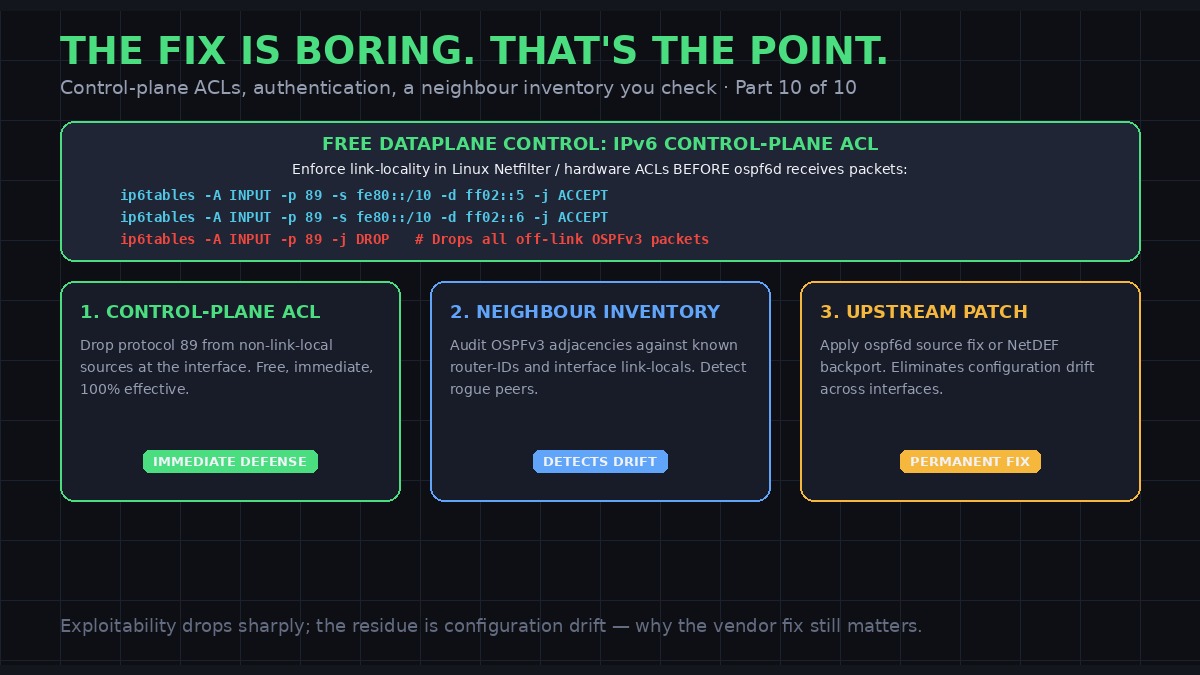
The chain is real and the fix is delayed — but the control that stops this
flaw cold is free, and it has been a standard part of serious network
operations for a generation. The reason this bug is dangerous is not that
it is unstoppable; it is that the good control is the boring one.
The remediation ladder, honestly
The corpus's deep-dive file lays out every path, with its reality:
| Path | Reality |
|---|---|
| Upstream FRR fix | Exists; check your build includes it |
| Debian stable packages | No fix in bookworm/trixie/forky — sid only |
| NetDEF contract | FRR's own foundation is a CNA and takes paid contracts; viable for a backport |
| Self-build | Small, well-scoped change; you own the carry-forward |
| IPv6 control-plane ACL | Drop OSPFv3 from non-link-local sources at the interface. Effective and free |
| OSPFv3 authentication | RFC 7166 or IPsec AH; defence in depth, not a substitute for the address check |
The control that actually works
Here is the key insight of the whole series: the fix for CVE-2026-119776
does not have to be written in C at all.
The flaw is that FRR accepts OSPFv3 from anywhere. The control-plane ACL
changes that at the network layer: on every interface participating in
OSPFv3, permit IPv6 protocol 89 (OSPF) only from link-local sources and
only to the protocol's multicast groups (ff02::5, ff02::6) — drop everything
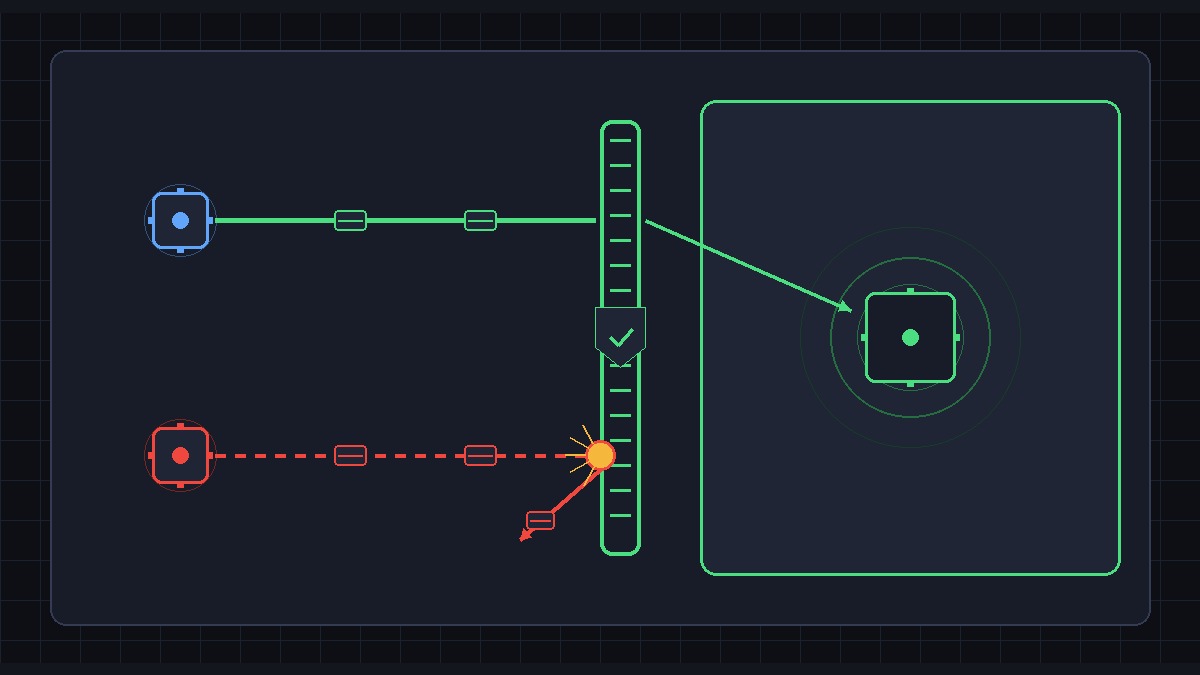
else. An OSPFv3 packet whose source is not link-local never reaches the
daemon. The missing check in software is replaced by a check in the
hardware/dataplane, operating outside the buggy code entirely.
Why this is the right control, precisely:
- It enforces exactly the rule RFC 5340 intended, at the layer where the
rule belongs. - It protects before the daemon's parse path — the attacker never gets a
chance to establish the adjacency that the bug would otherwise accept. - It is free — no contract, no backport, no waiting on a package.
- It is written once, per interface, and it does not drift with upstream.
The corpus names it plainly: "For most operators the effective control is
not a product: it is IPv6 ACLs on the control plane permitting OSPFv3 only
from link-local sources on participating interfaces, plus OSPFv3
authentication."
The blind spot in the productisable mitigation
The corpus also documents what the purchased controls cannot do — this is
its "C-mitigation" analysis (C=2):
- RPKI does not validate OSPF. It validates BGP origin announcements.
An IGP-level redirection that keeps the same BGP next-hop semantics can
be entirely RPKI-valid. - IPS coverage of OSPFv3 is thin. IGP protocols are rarely
deep-inspected; most IPS deployments do not have OSPFv3 parsers enabled
— and the legitimate versions of these packets are link-local
multicast, which many policies drop or ignore anyway. - The poisoned LSDB persists. Blocking packets does not remove an
injected LSA. You must clear the adjacency and re-flood.
So the purchased controls defend the wrong layer. The effective control is
the ACL, the neighbour inventory, and authentication: network hygiene, not
a product.
The residual risk
Even with an ACL at every interface, the corpus's residual-risk assessment
is honest:
"With a control-plane ACL and authentication, exploitability drops
sharply and the remaining risk is configuration drift: one interface
where the ACL is missing, one new link provisioned without it. That drift
risk is the reason the vendor fix matters more than the workaround."
In other words: the ACL works today, and it will keep working as long as
every interface has it. A network is a living thing — links get added,
interfaces get renumbered, configs get flattened in a templating error. The
drift risk is exactly why the vendor fix (a correct check in the daemon
itself) still matters more than the workaround, and why the delay in the
distribution packages is the one thing that should actually worry you.
The bottom line
Walk the whole series back in one breath:
- Part 1–2: FRR is the invisible default routing brain of the Linux
world; most of its users do not know they run it. - Part 3: inside it is an interior gateway protocol whose entire
security model is one idea — only same-link routers may talk. - Part 4–5: the architecture trusts that boundary; the boundary is
supposed to be enforced by link-local address checks. - Part 6–7: the checks were never written — in all prior released
versions (CVE-2026-119776), so the IGP becomes an unauthenticated remote
control plane. - Part 8: the fix exists upstream but not in the stable distributions
where the install base lives. - Part 9: the consequence is silent, area-wide traffic redirection.
- Part 10 — and this is the point: the way out is boring, free, and in
your hands today. IPv6 control-plane ACLs, OSPFv3 authentication, and a
neighbour inventory you actually check.
The disclosure never needed to be a disaster. It needed someone to look at
the protocol's boundary, and enforce it with the tool every serious network
already has: the access list. Do that, and the missing check in the daemon
stops mattering — until the version sprawl catches up with a package you
can actually install.
The series ends here. The corpus holds 24 other disclosures, each
walking the same road: what it is, why it won, where the trust broke, and
the way out.

Comments (0)